Wednesday, December 3, 2014

Pitt Town satellite airstrip and Hardie Ferodo test track

Pitt Town airstrip was a WWII airfield satellite of RAAF Richmond. Satellites and dispersal strips eased capacity constraints at primary air bases and dispersed aircraft for tactical security reasons.

Can you spot the now disused strip? I had a hunch but...
Then again Airstrip Road is a bit of a giveaway...
It wasn't far from RAAF Richmond...
And it was also the site of the Hardie Ferodo test track (for vehicle brakes and components). Some club motor sport events were also held here post-war.


Postscript... I have received an email from reader Rob who has taken the trouble to sketch the runway, the test track and more (thanks Rob!).

In the image below the red line is the HF proving ground. Rob reports that it has leveled areas raised in places to keep it out of what were regular floods, presumably. The floods I remember well from my childhood. I'm sure it still happens but it used to be quite catastrophic and regular in the past, until remediation and flood management work was done. 

The blue line is the actual airstrip. Again Rob reports that the surface is still quite visible in parts as you drive along Airstrip Rd. The kink at the southern end seems there for no reason, although it presumably made sense to someone when the land was parceled up and sold off over time.

The yellow line on the western side is where there are houses/buildings now, and Rob suggests that you can see clearly the flat hard surfaces that probably were the tie-down/flight-line areas. There are also some unusual looking depressions and berms that could have been dugouts near Pitt Town/Dural Rd.

Here's Rob's sketch:


 Well worth a visit, I suspect!


Indeed why not visit the full list of Sydney's airfields and airports?

Jamison Park airfield at Penrith - or is that Belmore Park airfield - and speedway!

Penrith was a center for aviation in Sydney before Richmond (1912, or perhaps 1914) - or even Mascot (1919). This is the brief story of 3 key historic sites for aviation in the Penrith - indeed greater Sydney - region: Emu Plains and LJR Jones (1911); Bill Hart and Smith's Belmore Park speedway and aerodrome (also 1911); and Jamison Park (possibly in the 1930s).

The 'flying dentist' William Ewart Hart operated from Penrith in these early years, circa 1911 onwards, from a site known as "Belmore Park", just north of the railway line. This site later became the Penrith Speedway and - as we often do with history - is now largely buried under new development. (Another Penrith Speedway was developed by Victor Sutherland, naming it Brooklands after, umm, Brooklands.)

Indeed the Belmore Park site is regarded as the first dedicated "aerodrome" in Australia. Shame we haven't done more to recognise that as an important fact...

The first manned flight of note in the Penrith region had been completed in November 1911 with William Ewart Hart’s flight from that same Belmore Park, Penrith to Parramatta Park, Parramatta in a Bristol biplane, taking about 20mins. Hart also flew what is regarded as the longest flight at that time in the Southern Hemisphere, from Penrith to Sydney Showground. It took just 55 minutes, including a stop at St Marys.

Hart, born in Parramatta, practiced dentistry at several locations and trained as an aviator at Penrith, at the private flight school known as the Aerial League of Australia. That operation was based at Belmore Park. The Aerial League itself had been formed in 1909 by George and Florence Taylor. Their selection of Belmore Park is reputedly the first instance in Australia of a piece of ground being set aside specifically for aviation purposes: ie arguably the first 'aerodrome'. Hart himself subsequently founded an aviation school at Belmore Park in January 1912 and had intention to do the same again at Richmond that same year, but was thwarted by an accident early that year.


Interestingly, Leslie John Roberts Jones was reportedly testing his experimental (initially steam-driven!) aircraft at Emu Plains at roughly the same time. L.J.R. Jones hailed from Bathurst but his family moved to Hereford St, Glebe in Sydney. In any event Jones too played an important role in the development of manned flight in Australia, becoming well known for his engine and aircraft designs and aviation engineering expertise. Jones used a field at "Eden Glassie", Herman Hollier's property at Emu Plains to put his experimental aircraft to the test. The aircraft, having been entirely built - including engine castings - at his parent's home in Glebe, was trucked (disassembled) in one night to Emu Plains. On 4th of June 1911 his super-heated steam-engined aircraft lifted off (or perhaps hopped) for a short distance. Unfortunately the impressive but fragile machine was damaged beyond repair by bad weather. Jones went onto design and build further flying machines and in so doing carve a sizable niche in aviation history for himself.  


On the other (southern) side of the railway is Jamison Park. Originally Penrith's racecourse (dating back to the late 19th Century) this park was still noted in the 6th edition of The Premier Street Directory of Sydney, circa 1940, as "Penrith Racecourse". And of course today "Racecourse Rd" runs north-south down one side of the park. But there are few if any remaining signs of that racecourse. This document from Penrith City Council gives more detail on the racecourse and South Penrith in particular. 

The Penrith Aero Club also operated from the Jamison Park site from perhaps the early 1940s until the late 1950s. Certainly the Penrith Aero Club was known to be conducting joy flights and training from Jamison Park during the 1950s.

In 1968 the Penrith Aero Club's disused clubhouse in Jamison Park was - I believe - moved, becoming the 'N. A. Hunter Pavilion', at Howell Oval. It didn't move far, if it moved at all - it's just on the other side of Jamison Road. 

Why 2 airfields in Penrith? And why are there so many other airstrips and army camps (mostly old and forgotten) dotted around western Sydney? The western and south-western fringes of the Cumberland Plain are mostly flat and open, and at the outbreak of both world wars were sparsely settled and quite distant from the main centres of population; despite that relative isolation they mostly had good rail links to Sydney. The army for example had established a base near Liverpool and later at Ingleburn. And the Royal Australian Air Force (RAAF) selected sites nearby or in similar terrain but more suited to aviation. One other reason for "going west" was the military value of being out of range of naval bombardment. 

The Penrith area is Mulgoa peoples' land, who spoke the Darug language. Jamison Park was named for Thomas Jamison, a pioneer landowner and First Fleet surgeon. 

Selected sources:
Penrith City heritage study (1) and (2) and (3)
Thornton Hall website
More on LJR Jones
More on Penrith Speedway

Checkout my list of Sydney and surrounding airstrips and airports.  There is a discussion in the comments to that page about a possible EAA or emergency alighting area for seaplanes on the Nepean River, adjacent to Jamison Road. (Alternatively that EAA was at the more remote Nepean Dam.)


or checkout my list of Sydney and surrounding airstrips and airports.   

Monday, December 1, 2014

Bankstown Airport - Sydney's "other" second airport

Bankstown Airport, once the busiest by movements in Australia but I'm told it's just 4th now. I think they are miscounting but anyway, that's the official story. Bankstown has multi-runway parallel strips, plus some crossing (but disused). There are three main parallel east-west runways, a long centre runway for high-performance aircraft, a northern runway for arrivals and departures, and a southern runway for circuit training.

Originally planned in 1929, but not established until 1940 as an RAAF facility. Subsequently taken over by the USAAF and established as a key strategic air base to support the war effort, circa 1942. It transferred from US to British Fleet Air Arm operations in 1945, and was known as Royal Naval Air Station Bankstown, or HMS Nabberley, until handed back to the RAAF in 1946. Interestingly, several "dummy houses" were built to make Bankstown Airport appear as a farm, with disguised hangers and fake roads.

There was an underground command post on Black Charlie's Hill with gun pits located within and around the airport to protect it from air attack. Another anti-aircraft battery was situated on high land on the corner of Bexley Road and Homer Street, Clemton Park.

de Havilland and its successors have been located at this airport since 1942, occupying the area south of the main runway. RAAF Mosquito "Wooden Wonder" bombers were built there. The primary (centre) runway (11C/29C) is 1,415m x 30m, limited to 50 tonnes MTOW.

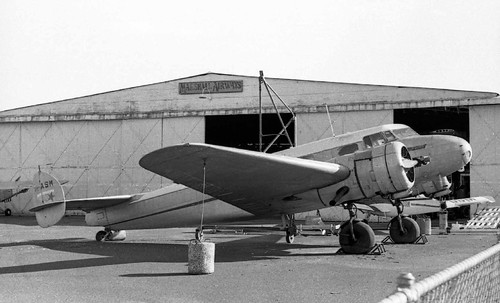
Marshall Airways and Sid Marshall's musuem was based here, too - very important information to any Sydney-born child obsessed with aviation in the late '60s and early '70s.  I undertook flying training here at Illawarra Airways, too, so it's of some personal interest. Not that I ever finished that training: I got distracted!


These days Bankstown is lumped into a commercial bundle with Camden via privatisation. That means user pays and "other use" optimisation, so - for me at least - some of the charm has gone. Again, that's life.